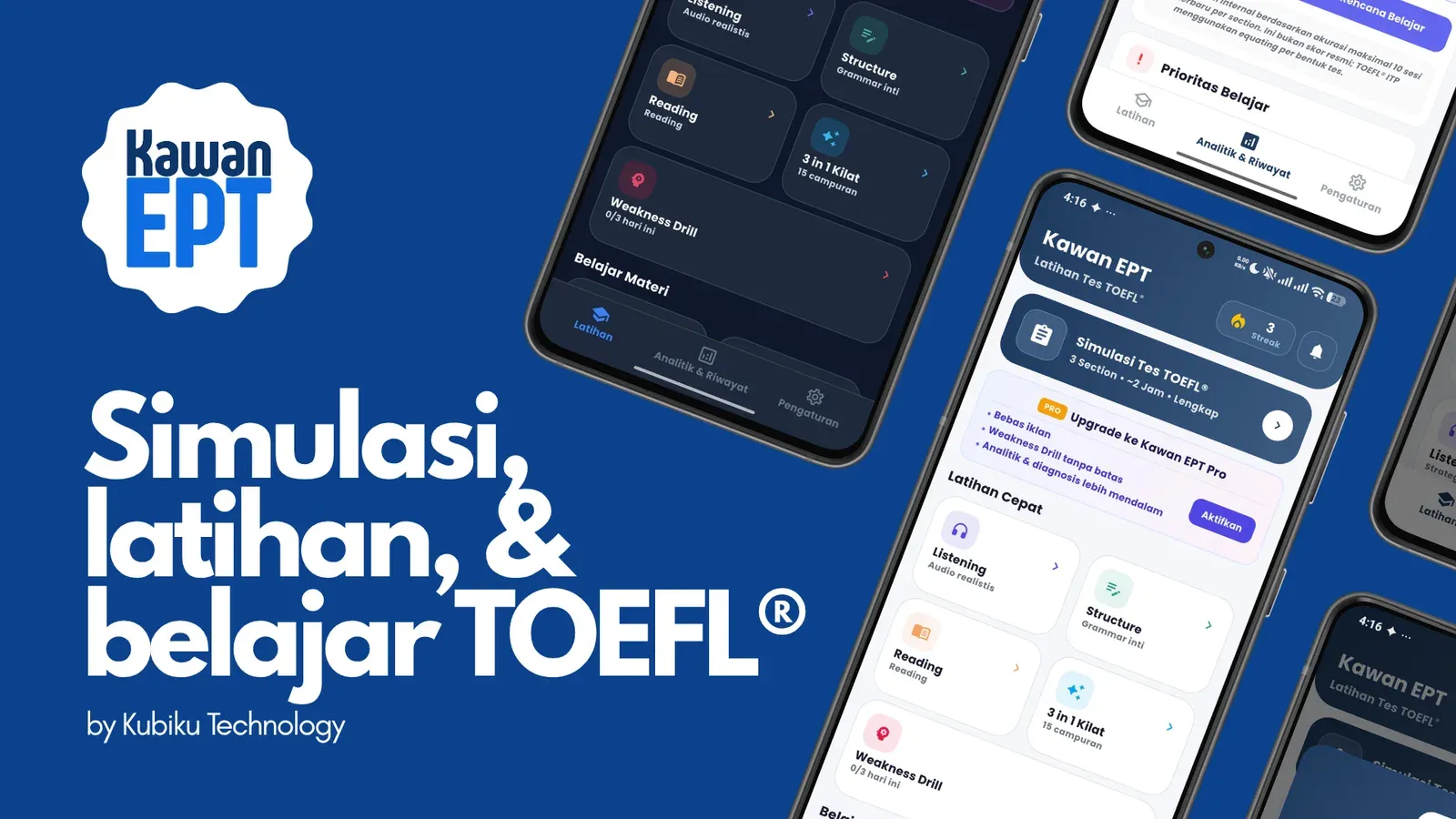
Kawan TOEFL Is Now Kawan EPT
Kawan TOEFL, the TOEFL® ITP practice app from Kubiku Technology, is now called Kawan EPT as of version 1.12.0. Questions, progress, Pro subscription, and the Play Store link stay the same.
Read more →Articles
Articles on study strategies, score calculation, tips to pass, and complete TOEFL and SKD CPNS material guides, written in plain language.
Kawan TOEFL, the TOEFL® ITP practice app from Kubiku Technology, is now called Kawan EPT as of version 1.12.0. Questions, progress, Pro subscription, and the Play Store link stay the same.
Read more →
English root words for TOEFL vocabulary: how DICT, PORT, and VIS plus prefixes like re-, un-, pre- and suffixes like -tion, -able build new words.
Read more →
Compare the cost of TOEFL Prediction, TOEFL ITP, TOEFL iBT, and IELTS in Indonesia as of October 2026, with example providers and tips to avoid paying twice.
Read more →
How TOEFL ITP scores are calculated: the official 310 to 677 formula, worked examples, and estimated correct answers needed to reach 500 and 550.
Read more →
Causative verbs in TOEFL ITP Structure: the 5 formulas for make, have, get, let, and help, when TO or the past participle is needed, plus traps and a quiz.
Read more →
Conditional sentences in TOEFL ITP: formulas for Types 1, 2, and 3, inversion without IF (Had, Were, Should), and the Unless trap, with sample questions.
Read more →
Conjunction vs preposition in TOEFL ITP: although vs despite, because vs because of, and 3 more traps in Structure and Written Expression, with a quiz.
Read more →
Word pairs in TOEFL ITP Structure: both ... and, not only ... but also, either ... or, neither ... nor, and more, with right and wrong examples and a quiz.
Read more →
Degree of comparison in TOEFL ITP Structure: comparatives, as...as, superlatives, the more...the more, and that of/those of, with common traps and a quiz.
Read more →
TOEFL ITP error identification: the 5 most common traps in Written Expression questions 16-40, with example sentences, how to spot the wrong word, and a quiz.
Read more →
Gerund and infinitive in TOEFL ITP: 5 patterns for when to use V-ing or to + verb in Structure and Written Expression, like enjoy reading, with a quiz.
Read more →
10 idioms that often appear in TOEFL ITP Listening Part A, with meanings, sample dialogues, and the literal-meaning answer traps you should avoid.
Read more →
5 fatal TOEFL ITP mistakes that drag scores down, from skipping Listening practice to never taking a full simulation, and practical ways to avoid each.
Read more →
15 academic words common in TOEFL ITP Reading vocabulary questions, with meanings, synonyms that often appear as correct answers, and example sentences.
Read more →
TOEFL ITP Listening Part A: 10 common patterns and traps, from sound-alike words and double negatives to wish sentences, with sample dialogues and tips.
Read more →
TOEFL ITP Listening Part B and C strategies for long conversations and lectures: preview options, follow the order, catch signal words, pick the paraphrase.
Read more →
Time targets per question for TOEFL ITP Listening, Structure, Written Expression, and Reading, plus a last-2-minutes routine so no answer is left blank.
Read more →
Do you need to memorize thousands of words? Do wrong answers cost points? We bust the 5 most common TOEFL ITP myths, with the facts and what to do instead.
Read more →
Noun and quantifier traps in TOEFL ITP Written Expression: much vs many, fewer vs less, number vs amount, uncountable nouns, and plurals like criteria.
Read more →
Parallel structure in TOEFL ITP: 5 rules for and/but/or, correlatives, comparisons, and the more, in Structure and Written Expression, with a quiz.
Read more →
Passive voice in TOEFL ITP Structure: 5 patterns including be + past participle, has been, modal passives, and being + past participle, with a quiz.
Read more →
TOEFL ITP vs TOEFL iBT vs IELTS vs TOEFL Prediction compared by format, skills tested, scoring, recognition, and cost in Indonesia.
Read more →
Inversion in TOEFL ITP Structure: 5 patterns, from negative words and only first to conditionals without if, which are required, with examples and a quiz.
Read more →
5 TOEFL ITP Structure patterns tested most often: inversion, parallel structure, appositives, passive voice, and double comparisons, with examples.
Read more →
Commonly misused prepositions: in, on, at; for vs since; between vs among; on time vs in time; to vs for, with right and wrong examples and a TOEFL quiz.
Read more →
Reduced clauses and participles in TOEFL ITP Structure: how to choose -ing or -ed fast, plus the double verb trap and dangling modifiers, with a quiz.
Read more →
A 30-day TOEFL ITP study plan in 4 phases: Structure, Listening, Reading, then full simulations, with daily targets and how to use an error log.
Read more →
Relative clauses in TOEFL ITP Structure: 5 patterns for who, whom, whose, which, and that, with the common traps, examples, and a quiz.
Read more →
Subject-verb agreement in TOEFL ITP: 5 trickiest rules, from everyone and along with to neither ... nor and a number of, with examples and a quiz.
Read more →
Subjunctive in TOEFL ITP Structure: verbs of urgency, the BE form, NOT + base verb, impersonal adjectives, and the he/she/it trap, with sample questions.
Read more →
22 TOEFL ITP grammar practice questions for Structure and Written Expression in three levels, with an answer key and why the other options are wrong.
Read more →
Guess the part of speech from the suffix in TOEFL ITP Structure and Written Expression: spot nouns, verbs, adjectives, adverbs, the -ly trap, plus a quiz.
Read more →
5 TOEFL ITP Reading question types: main idea, vocabulary, pronoun, NOT/EXCEPT, and inference, with sample questions, traps, and quick ways to answer.
Read more →
How to score 500+ on the TOEFL ITP: practical tricks for Listening, Structure, Written Expression, and Reading, plus daily study habits that work.
Read more →
5 quick-answer tricks for TOEFL ITP Structure, Listening, and Reading: fast elimination methods that save time, plus the exceptions to each trick.
Read more →
TOEFL ITP Reading time management: how to split 55 minutes, an efficient workflow, and 5 shortcut tricks to finish all 50 questions in time.
Read more →
A complete guide to the CPNS SKD: TIU, TWK, and TKP materials, number of questions, time limits, and how passing scores are calculated.
Read more →
How CPNS SKD scoring works: TIU, TWK, and TKP score formulas, passing thresholds, strategies to reach the passing grade, and progress tracking.
Read more →
Smart SKD CPNS strategies: time management, tricks for TIU questions, the right TKP mindset, and study habits that help you pass the threshold.
Read more →
Always confused about 'A University' vs 'An University'? Not sure when to use 'The'? Find the answers here!
Read more →
A complete guide to using To Be in English. Stop saying 'I am agree' or 'She is go'!
Read more →
A beginner's guide to understanding the 8 parts of speech (Noun, Verb, Adjective, etc.) in English. The essential foundation for solid grammar!
Read more →
A headache-free guide to distinguishing English Pronouns. Subject, Object, Possessive, and Reflexive Pronouns, all broken down right here.
Read more →
A complete breakdown of -s/-es rules and a list of tricky Irregular Nouns. Never say 'one childs' again!
Read more →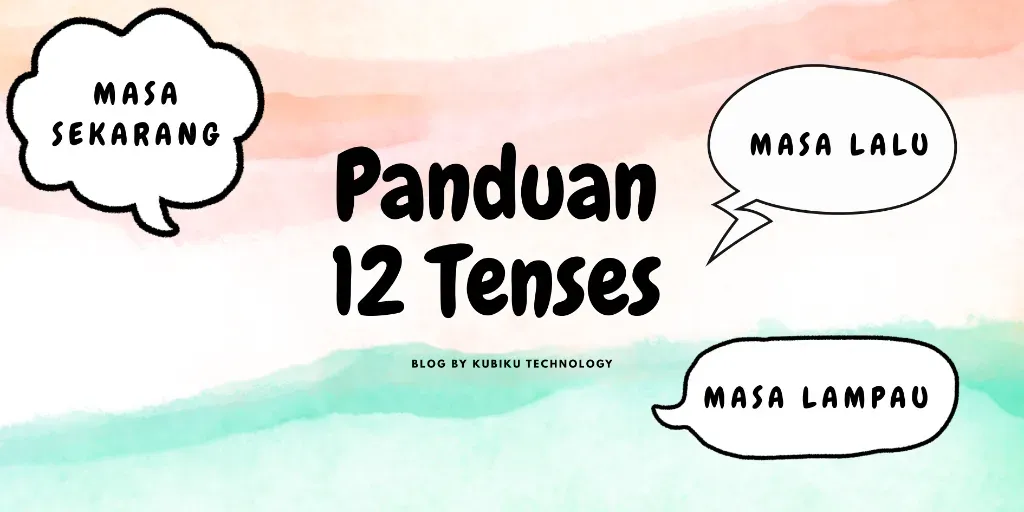
A practical guide to understanding time (past, present, future) without memorizing complicated formulas.
Read more →
Learn everything you need to know about the TOEFL test, from test structure and types to tips and strategies for achieving a high score.
Read more →Got a question?
Quick answers about Kawan Apps